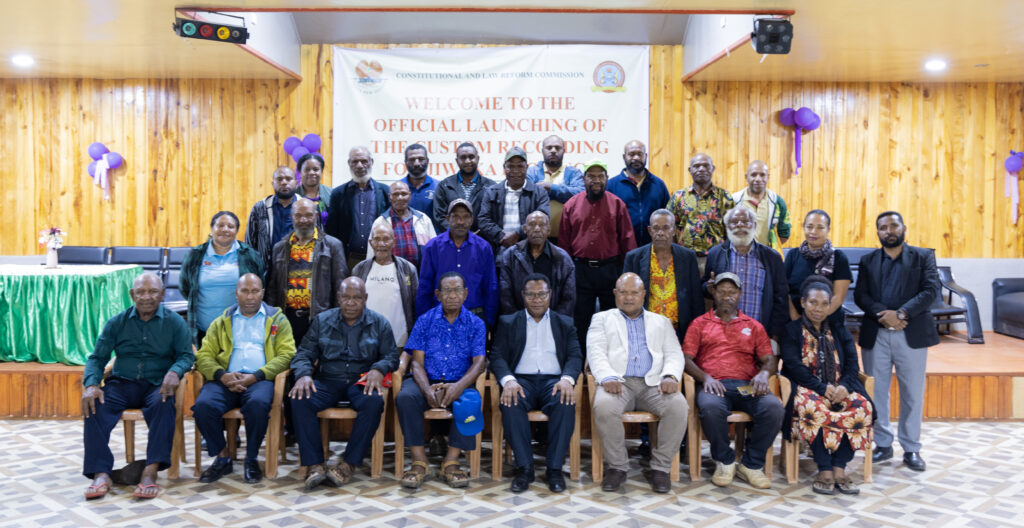
Port Moresby, 08 May 2026 – The Constitutional and Law Reform Commission (CLRC) has successfully completed an intensive two-week custom recording exercise for Jiwaka Province, marking another significant milestone in the Commission’s ongoing efforts to strengthen its special mandate in the development and monitoring of the Underlying Law of Papua New Guinea, as provided under the Underlying Law Act 2000 and the CLRC Act 2004.
Throughout the two-week exercise, CLRC consulted with and documented the customs of the four main language groups in Jiwaka Province. These include the Kuma Language Group (comprising both South and North Waghi Districts, bordering the eastern township of Kudjip); the Eknii Language Group (covering parts of South and North Waghi Districts in the Middle Waghi area); the Melpa Language Group (South Waghi District, bordering Western Highlands Province); and the Narak Language Group (Upper, Middle and Lower Jimi Districts bordering Madang Province).
Participants involved in the custom recording exercise were carefully identified with the assistance of the Jiwaka Provincial Administration. These participants included village elders, village court chairmen, magistrates, peace and good order officers, and respected village leaders.
The customs recorded from the four language groups covered a broad range of customary laws and traditional practices governing leadership and societal structures, family relations, land ownership, sorcery, criminal and civil wrongs, contract arrangements, maritime matters, and other important customary values and practices. The exercise was guided by CLRC’s comprehensive questionnaire framework, designed to ensure all relevant customs were thoroughly captured, documented, and linked to existing gaps identified during the recording process.
As part of the exercise, the Commission also undertook further cultural research to better understand the unique traditional artefacts used by the different language groups and their specific cultural significance, including a special visit to the Koskala Cultural Site in the province.
CLRC is now in the process of refining and vetting the raw information into a legally structured document. Upon completion, the report will be presented to Parliament as a customary law report for declaration as the recognized customs of the respective societies. Once recognized, the courts may apply these customs, in accordance with the Constitution and the Underlying Law Act 2000, in determining cases and progressively developing the principles of the Underlying Law.
Jiwaka Province is the second province selected by CLRC for the custom recording exercise, following the successful completion of the pilot exercise in Central Province. To date, the Commission has completed full documentation of the customs of Central Province, representing a major achievement in CLRC’s broader efforts to develop a truly home-grown Constitution for Papua New Guinea.
CLRC Secretary Dr. Mange Matui underscored the importance of the program, describing it as a national initiative that directly supports Goal No. 5 of the National Goals and Directive Principles, which strongly advocates for Papua New Guinean Ways.
Dr. Matui stated that the exercise reflects the Commission’s continued commitment to ensuring the Constitution and legal system of Papua New Guinea genuinely embody the customs, traditions, and aspirations of ordinary Papua New Guineans.